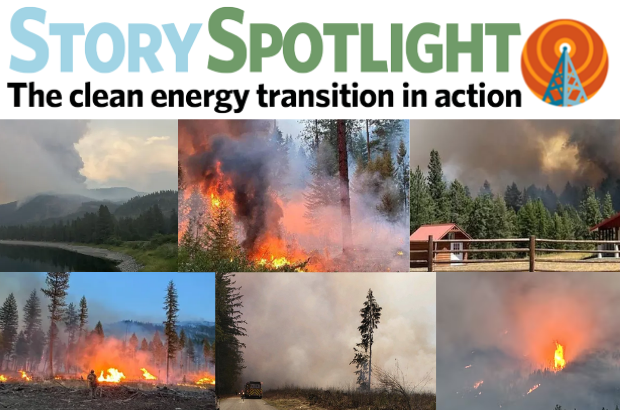
This personal account is part of an ongoing series profiling personal impacts from wildfires, curated by Climate Solutions. With global warming contributing to more frequent and fierce wildfires around the globe, the series presents personal experiences to further collective connection, learning and action.
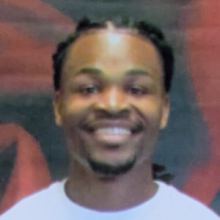
James Ellis is from Tacoma, WA. He trained to become a wildlands firefighter through a program with the Washington Department of Natural Resources and the Department of Corrections to offer employment and career paths to those currently incarcerated. He told us his story over a series of calls in between days on the job; the first part of his story is here.
Kimberly Larson, Climate Solutions: You grew up in western Washington, but like many others from the state you have only more recently gotten to see some other areas with the travel at your current firefighting job with the Department of Natural Resources. What was it like to see some parts of the state you haven’t yet seen yet? Could you describe a memory, some experiences, for us?
🔊 LISTEN: James describes some of his favorite spots encountered on the job
James Ellis: Arriving at OCC (Olympia Correctional Facility) for camp, and then getting on DNR, it was November 2024. I was outside the prison, I’m in the Hoh Rainforest—just to be there was new to me, I never knew it existed coming from the City of Tacoma… how far we were to the ocean, Strait of Juan du Fuca, to seeing the Pacific Ocean and even Canada.
One of our jobs was trash pickup and a lot of the dudes I was out there with knew I hadn’t seen the Pacific Ocean before. I overheard them say to the crew boss "we want him to see the ocean, he’s never seen the ocean." And the crew boss says, "we don’t have time for that…” And to my surprise, we’re driving down the 101 and the fellas are like, “Hey Lucci (that’s what a lot of the guys call me), you ever seen the ocean before?” and I say, “No, man!” So they say, "come over this side of the crummy [the bus]. Look at this window, you're going to see the ocean.. . . "
And through the breaks of the trees and the tree line, I started to see some swells… and then we got to a part where it was real open, a clear view, and they slowed the crummy down, and in that moment I could see nothing but water as far as the eye could see.
If I was a crier I’d really shed some tears. But I really felt it, it was impactful, it was something that wowed me, an experience I’ve never had. The guys on the crummy were more excited for my excitement!
It did something to me where it opened up my mind up more. What it did was bring a reminder that I’ve been able to accomplish goals that I’ve set for myself to even be in that moment. One of the things about being incarcerated, just like in society, you have to choose to be on the positive path. And it’s a hard thing every day, day in and day out due to the type of environment I am in. But good decisions put me there that day, looking at the ocean.
And I was in shock, I was in awe–we’re looking across, at the backside of Japan! The swells were so big. Got me thinking about how powerful the swells were, the life out in the ocean. I’m definitely looking to get more involved when I’m out of prison, and go out on a boat to see the ocean.
I've also never seen another country a day in my life, and one day we’re going up to Port Angeles, and I see Victoria and they said, that’s Canada right there. It blew my mind to see more of the Pacific Northwest, how big this world is, what I’ve been missing out on.
And then traveling to different parts of Washington, seeing the Coulee Dam, the blue lake, never seen something beautiful like that before, just seeing the changes of the terrain from the east to the west and everything in between. It’s just a beautiful state, and to see more of this country more of this beautiful world, it’s very impactful.
Climate Solutions: This part of your story you wanted to title 'in the face of danger,' and I was hoping you could share about some of the dangers you faced growing up and how you have reflected that for you, and for possibly others who are incarcerated and also firefighters, your upbringing in some ways helped shape you now in the face of danger now when it comes to fire vs. what you had to face earlier in life. Could you describe that?
🔊 LISTEN: James describes his youth and some of his fellow firefighters’ backgrounds for the job
James: Just for us incarcerated individuals that I know of, including myself, just the ways we were raised in certain neighborhoods and in certain communities, some of the things we were raised amongst, for myself there was a lot of violence. Gang violence and just violence all over. From my mom having to be violent to protect herself and us kids against other men and other women, just a lot of those types of things and growing up for me and my peers at the time, in ways we were put in positions where you had to be tough. I would rather be predator than prey, be the victimizer than the victimized… that kind of mind set.
But that bravery, standing up for myself and my siblings or my peers, that added to my character as far as being an individual who faces challenges, who faces adversity, doesn’t back down from those things. But it’s now being able to be more skilled at how I can utilize those types of qualities, instead of in a more negative way, in a more positive way. I can be helpful, protect, save people's lives, have a positive impact.
Yeah, a lot of us come from similar backgrounds, if not the same background, where life is crazy, hectic, and we were put in some crazy situations where we had to survive. I think it comes down to that mindset of survival. Going to the extreme to survive, and wanting to survive.
And a lot of us have the mindset of being protectors, right? A lot of us grew up even if you’re not the oldest sibling of maybe many kids, just protecting your people. So on a larger scale outside of just protecting your friends and family, here we are trying to protect people in society, in communities, protecting things that are bigger than ourselves, groups bigger than ourselves.
I think that is a lot of where it comes from.
And there are some wild guys I’ve run across, who have played sports as well, so they have that type of mentality. There are guys who were in the military, where they picked up that psychological mindset. I feel like we all have a psychological fortitude that’s strengthened through what we’ve endured in the past, and with what we’ve been going through in the midst of doing time in prison and what we’ve overcome. And applying it to jobs like this, ah, it comes easy, natural to us.
A lot of people are intrigued and wowed at the same time of just how brave we are, and the work we put in, our dedication and commitment. But yeah, I think it comes from our backgrounds, our different walks of life, that contributes to what we do today.
Climate Solutions: A lot of folks might have faced fire but it might not be at the scale you have. For many of us, we’ve only faced a small fire, maybe in a kitchen, but it’s still memorable! A lot of firefighters also talk of the memories of their first “live fire” on the job. Could you tell us about a memory facing live fire for the first time as a firefighter, how it was to be in the face of that danger?
🔊 LISTEN: James describes early experiences facing live fire on the job
James: The first fire I tended to was May of 2022, in Ocean Shores and Copalis Crossing, Washington. It was more of a fire in the root system of the trees that had already been removed, so it was in the ground, but there were flames, big slash piles and all the things that could blow this thing up more in more wooded areas too. I remember getting there—I spoke about it before, this was the fire I went to when there were two little girls… but after being briefed and what position we were going to take, how we were going to flank this fire, we split up into two crews, 20 guys in a crew.
I remember seeing a helicopter that had just dropped water on this thing. Seeing that for the first time and how low it was.I had never seen a helicopter up close—that’s another thing to take in. Some of the machinery and equipment you see for the fires time—wow, that’s huge; I had never used one of those. But once we were briefed and told what our assignment was we just dove into it.
And the fear is there, yes, but we’re more in fear of letting this thing get away from us—we’re in fear of the catastrophe that it could cause even more than the damage that is already done. So we have the urgency with a clear mind, and controlling our fears and our adrenaline. You’re just hyperfocused on the task and eliminating this fire.
There was one part when we were working when we were literally standing with an inferno under our feet. Our feet were getting hot. One thing with fires, white ash—that’s hot! We didn’t understand it until we were in the midst of it. And the crew boss was saying, you got to get out of there, And sure enough, we’re standing there and mopping up and it was like an oven underneath us.
We had another fire we tended to and the flames up to four feet and growing. That was intense—we were on the steep side of a mountain. It was a climb, let alone the work to be done. We had old trees hollowed out—and the fire is in there and growing. It’s scary, yes it is.
Climate Solutions: We’re getting into “active fire season” where the work looks different than the “off season” for you and your crew. One thing you’ve already noted but for folks to understand is the pay is different—more during active season. Could you describe a bit what your day or the time looks like when you’re out working during active season? When folks see smoke or hear about a fire in the news, what are you doing in those times?
LISTEN: James gives a first-hand account of active wildlands fire season
James: So in the months of May or June or July… which is called fire watch, we’re preparing and out patrolling. When our dispatcher hits our boss on his radio, they let us know “hey, in this area there is a fire going on,” and they give out the location, they give out how many acres, how it’s acting, the character of the fire due to the winds, or downhill winds, things of that nature. All that information is passed to the crew boss and the crew boss relays it to us, the type 2 firefighters, us inmates.
And from there it could be an initial attack, which is where we’re showing up right on the scene to construct a line to contain the fire so it doesn’t spread and go any further. Or it could be simply to assist on a constructed line , helping other personnel who had showed up to the fire already. Or if there's been water drops from helicopters already—all that information is sent to the crew boss and we’re updated and briefed upon arriving at that fire.
So say it’s an initial attack, flames are going and we get to wherever this fire is at. Depending on how we have to navigate there, we usually have to walk on foot. Could be anywhere to a mile or two before we actually get to the fire itself.
There’s a process we have, how we line up. When we get deployed usually to most fires it’s usually 20-man crews, and if there’s any other assistance to be had that’s going to be called in, other reinforcements. So a 20-man crew shows up—2 crew bosses, 10 guys on each crew.
We have an order that we have as far as what tools we use. The tools that we use: we have ropes, we have Pulaskies [a firefighting tool that can be used as an axe], we have McClouds [a heavy rake for firefighting]. Due to this side of the mountains,the eastern side of the mountains, we have to have these tools called pounders because there is a lot of rock… so you need something stronger to break through the rock you’re digging through in the dirt to get to mineral soil.
With that we have our line up and we get briefed on how we’re going to go about this fire, what it’s looking like, what’s the character of it, how are we going to approach this fire, paying attention to the wind because that plays a major part. Checking for spot fires, looking for and creating anchor points, safety zones, escape routes. Things that are very important along with constructing the fire line to contain the fire.
And when we start digging a line, we’re trying to make it three feet wide, not too deep but deep enough to hit mineral soil because we understand that prevents fire from burning anymore. So we try to get debris, any kind of roots, trees and other plants cleared out.
We could be digging for miles on end to contain the fire.
At the same time digging line, we’re communicating, and we have two sawyers—two dudes on saws maybe cutting burned timber, and other things that could be burned as fuel. One of the things we say, “if it’s black keep it in the black” as our job is to protect the green—the unburned fuel. If it’s black it’s already been burned, so if it’s black throw it back in the black.
So there’s a lot of different things going on. A lot of factors. Situational awareness is very key. Looking up, down and all around. We need to repeat back commands to make it clear we have it, we’ve understood. And the work continues. We could be digging anywhere from 4 to 5 hours, to 10 to 12 hours if need be.
Once we’ve contained the fire itself, we have another process called mop-up where we get into in the black, we’re checking for hot spots, checking for any other fires small enough to approach to put out. We’re dealing with trees, stumps, and we need to dig deep into there to put the fires out. We understand when fires get into the root system the fire could be in there for days so we want to get that, and there’s a lot of digging. We want to make sure this fire is completely killed off and dead before we leave. And if it’s more intense, we could have aircraft dropping water and different kinds of retardants.
It’s very chaotic and stressful, and at the same time it’s fast paced; everyone is physically going at it the best way possible. All personnel, all hands on deck. It’s a sight to see, but there’s a lot of adrenaline when you’re in it.
Climate Solutions: Are there just some basics that you can walk through for people wondering, you know, what can I, what can any person do here to help out help your work, right, even from afar?
🔊 LISTEN: James shares what you can do to help wildlands firefighters starting now
James: Yeah, so, so I've said this before, this is our planet, all of us. We all live here. Yes, we have people who sign up for these jobs and, you know, people who go to school and study this type of stuff. I just feel like individuals need to be more in tune with that and display that and act on that and just make sure you get rid of your propane tanks properly, dispose of waste property, your garbage and things.
Now, I'm not saying everybody's going to follow suit, but we need more individuals to start setting an example in campgrounds and wooded areas. As much as you feel like you can litter, you should take it upon yourself to clean it up, because this is where we all live.
This isn't just like somebody's house that you go to. That's not my responsibility. You know, we all live here on planet Earth, and here in Washington State.
This place is for all for us. So we need to take care of it better, like our ocean. We need to take care of our land, for the land animals, protect the diversity.
So that's the biggest message I can offer to give, like, we're all responsible and we all play a part. More people are stepping up to that, but it needs to be focused in on more and talked about more to get other people on board, especially our young generation. Because, you know, as older generations, we start to fade out, right? We've got to leave some behind for them.
And if this is the type of things we can leave behind for them, not saying that it's not already happening, but actually doing so a lot more—and a lot louder.
______________________________________
For more resources on wildfire prevention: Wildfire Prevention | Department of Natural Resources
PHOTO CREDITS: Dennis Roberts; InciWeb; NW Washington Fire Info; Pierce County Firefighters; WA Dept. of Natural Resources.