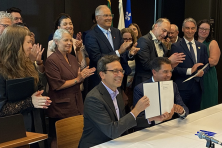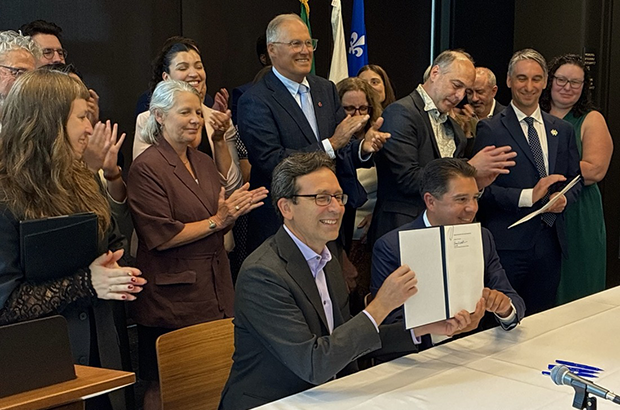
Washington Governor Bob Ferguson signed a historic agreement Thursday to formally link Washington state’s carbon market with the markets in California and Québec. This is a monumental moment for partnering across state and country borders to reduce regional climate pollution, and send a strong signal that subnational jurisdictions can and will take up the mantle of effective climate policies. The intent of this agreement was baked into the design of the Climate Commitment Act when they first passed the law in 2021, and those efforts paid off today.
Hosted at Safeco Insurance Building in downtown Seattle, Governor Ferguson invited speakers that spanned climate & labor advocacy, regulatory agencies and government officials from across the region who have been closely involved in negotiating and designing this agreement, including:
- Casey Sixkiller, Director, WA State Department of Ecology
- Rep. Joe Fitzgibbon, WA State Legislature, LD-34
- David Ruiz, Government Office of Québec, Seattle
- Cassie Bordelon, Climate Jobs Washington
- Leah Missik, Climate Solutions
Key Quotes for use in coverage:
Washington joining forces with California’s and Québec’s programs shows that even without federal leadership we can still take meaningful steps to address the climate crisis and cut pollution. California is the world’s fifth largest economy, and if you add Washington and Québec, combined, we are the world’s fourth largest. Let me emphasize that: together, as the world’s fourth largest economy, we have capped climate pollution and are investing in solutions. The climate crisis transcends boundaries and so does our response. - Leah Missik, Washington Legislative Director, Climate Solutions
“This agreement marks real progress toward the regional cooperation we need to tackle climate change at scale” said Stephanie Burkhart, State Director for The Nature Conservancy in Washington. “As the work continues, every jurisdiction has to make sure the program delivers tangible benefits for communities, especially those that have long carried the heaviest environmental and health burdens. Its success depends on building a system that cuts greenhouse gases across the region and brings cleaner, healthier air to those who need it most.”
“Washington, California, and Québec are proving that we can continue working together across borders to address the climate crisis — in spite of national governments bent on rolling back progress,” said Caitlin Krenn, Climate and Clean Energy Director at Washington Conservation Action. “Today’s agreement is a milestone, and we must ensure that Washington continues to deliver urgently needed investments, particularly to Tribal Nations and communities hardest hit by climate change.”
“Since our founding, Clean & Prosperous has been a staunch advocate for linking Washington’s carbon market with California and Québec. Linkage provides significant near- and long-term benefits, including program durability, a more efficient, affordable market, and enhanced collective ambition across jurisdictions,” said Michael Mann, Executive Director, Clean & Prosperous. Washington state is set to join the fourth-largest carbon market in the world, strengthening our subnational presence on the global stage, and ensuring we continue to lead the nation in driving down air pollution while generating revenue to invest back into local communities.
Leaders from Washington, California, and Québec discussed the importance of a linked market at the Clean & Prosperous 2026 Future of Carbon Policy Forum. More information on that conversation is available here.
Why It Matters
- This agreement is proof positive that the ambitious cap-and-invest model works and can be adopted by other states and governments. This is critically important with the federal rollbacks on climate protections and clean energy investments. This incredible regional coordination has built positive momentum and created roadmaps for other states and jurisdictions to follow and join.
- Bolstering one more piece of the climate-puzzle: This agreement builds on Washington’s suite of landmark climate policies - a Clean Fuel Standard, the Clean Energy Transformation Act, clean building codes, and more – further bolstering coordinated, tangible, and regional progress in lowering emissions.
- Covered entities will have more price predictability to plan their decarbonization efforts. Joining with a larger market means more participants, which will stabilize market prices. This reinforces the program’s long-term stability, bringing more certainty that the program - and climate policies like this - is here to stay, and thus covered entities will be better able to plan for their required decarbonization under the cap. This means steadier, more coordinated emissions reductions that go beyond just one city, one business, or one family - this is emissions reductions at scale.
- Price stability allows for better investment planning by the State Legislature. More predictable pricing means even more predictable revenue streams from each quarterly allowance auction, helping the State Legislature better plan our climate investments in the long-term.
What comes next? The Department of Ecology is completing rulemaking for market regulatory changes - notably the implementation of HB 1975 - although this rulemaking will be completed in the next few months and should not impact the linkage process or timeline. California and Québec must complete additional rulemaking, and the California Air Resources Board (CARB) must vote to complete linkage, before all three jurisdictions can hold joint auctions. It’s anticipated that Washington will begin operating a linked market in 2027.