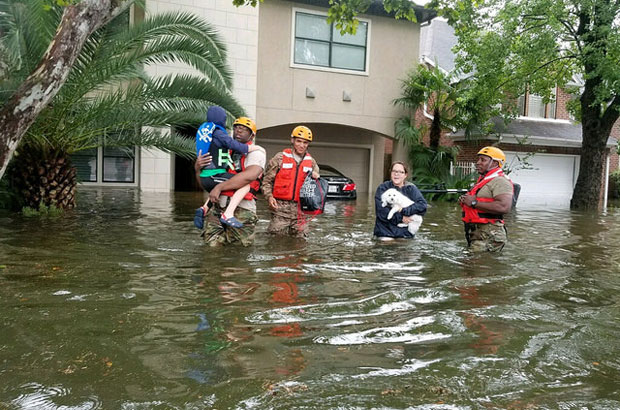
Houses, streets and entire neighborhoods sinking below the rising waters. White-crested waves flowing freely over the usual course of an interstate highway. Swamped oil refineries and exploding chemical plants. More rain in just 4 days than rainy Seattle or Portland receive in a full year. Some 30,000 people displaced from their homes, and a quarter of a million without power.
Hurricane Harvey this week wreaked painful havoc on Texas and Louisiana—at least 37 have lost their lives to the storm, a number sure to increase—and impacts of the disaster will continue to unfold in the weeks ahead. Further away from our home, this year’s monsoon rains have proven to be even more deadly for cities and towns in India, Bangladesh and Nepal, where more than 1200 people have died, and tens of millions displaced. Flood-related mudslides in Sierra Leone took over a thousand lives just weeks ago.
In the face of such tragedies, our first thought is to tend to the victims, and to help, however we can. Those who are able to donate resources to help those in need have many avenues to choose from. This article from ProPublica includes some essential advice on how to think about disaster relief contributions to Houston communities. The city-established Greater Houston Community Foundation is prepared to distribute funds to those in need, and Vox has compiled a list including other local, Texas-based charities. The Houston organization Texas Environmental Justice Advocacy Services (tejas) works on critical environmental justice issues such as those sure to be exacerbated in Harvey’s aftermath.
At the same time, we must not avoid talking about the grim lesson these disasters offer us about the increased risk and frequency of such catastrophic weather events that come with a changing climate. The tragedy faced by those affected by recent (and ongoing) flooding, as well as the colossal economic cost, should also prompt us to think carefully about the choices we face as a society about the energy we use.
It has become increasingly hard to deny that the conditions that helped make these storms so devastating—warmer-than-usual ocean waters, warmer air—are going to be more common features of life on Earth thanks to global warming. Houston itself has seen four 100-year flooding events since the spring of 2015. Events such as these should only heighten our collective sense of urgency to stop making things worse by continuing our reliance on fossil fuels and the carbon pollution they produce. Work towards climate progress, towards an economy based on 100 percent clean energy, has never been more crucial than now.