Oil shocks hit Northwest households hard. When global disruptions like the war on Iran shake the fossil fuel system, the consequences ripple quickly through the region. Prices spike overnight and fall slowly, rising like a rocket and drifting down like a feather.
This vulnerability isn’t only triggered by international conflict. Local failures in the region’s own fossil fuel infrastructure have produced the same pattern. The Northwest’s transportation system is built on a fragile foundation, and the cracks show every time the system is stressed.
The Northwest’s dependency on fossil fuels puts us at risk
When global turmoil exposes the risks of relying on fossil fuels, local breakdowns make them impossible to ignore. The Olympic Pipeline is the clearest example of how one failure‑prone piece of infrastructure can send shockwaves through the Northwest’s fuel supply.
The Olympic Pipeline runs roughly 400 miles and carries much of the gasoline, diesel and jet fuel used in Oregon and Washington, including at the region’s major airports. In late 2025, the pipeline experienced a leak; its fifth that year, and its 27th incident since 1999. Both Washington and Oregon governors declared states of emergency. The pipeline’s history also includes one of the region’s worst disasters: in 1999, more than 277,000 gallons of gasoline spilled into Whatcom Creek in Bellingham, ignited and burned through the city, killing three people.
These disruptions have repeatedly spiked fuel prices up by 50 to 70 cents per gallon on multiple occasions over the past few decades. That’s not unlike the spikes and speculation triggered by recent instability due to the US war on Iran. And during these price surges, the winners are rarely Northwest households.
The war on Iran is already creating another short-term windfall for major oil companies. This pattern is familiar: global oil and gas profits averaged about $1.5 trillion in recent years, then jumped to around $4 trillion in 2022 during similar windfalls.
Why fossil fuel systems are always fragile
Our fossil fuel-powered system, particularly for transportation, depends on a long and brittle chain: oil extraction, refining, pipelines, tanker ships, fuel terminals, transport trucks, and gas stations with working pumps. When one link breaks, the entire system feels the strain. Oil is a globally traded commodity controlled by a small number of powerful companies and a coordinated group of oil producing nations. Every country competes for the same supply.
The United States has been a net oil exporter since 2020, yet global markets still set the price. When supply tightens or countries are cut off, buyers simply bid higher for U.S. oil. That pushes prices up everywhere, including here in the Northwest.
The Northwest’s clean energy abundance is the path to energy security
The Northwest doesn’t produce fossil fuels, we import them. But we do produce abundant clean energy here at home. Solar, wind, wave and geothermal power can be built quickly, cost less over time, and are generated in local communities. Unlike fossil fuels, these resources are not tied to volatile global markets, local supply disruptions, or price spikes driven by conflict. They can power cars, homes and businesses, strengthening energy independence and keeping more energy dollars local.
Electric vehicles and their charging (e.g. fueling) system do not depend on a single fragile supply chain. They can charge at home, at work, at public stations and increasingly alongside rooftop solar or home batteries. Many EVs can also provide backup power during emergencies, keeping homes warm, phones charged and essential devices running.
As microgrids and virtual power plants expand, the electric grid becomes more distributed and flexible. It can responsively route around failures instead of collapsing when one part breaks.
Electricity prices are far more stable than gasoline
The cost to charge up an EV is more predictable and consistent than fueling at the pump. Electricity rates can rise, but they are regulated, reviewed in public, and shaped by decisions state leaders can influence. These decisions include oversight of utility spending, ratepayer protections set in state law, and investments in cheaper clean energy, storage, and grid modernization.
Right now, charging an EV in the Northwest costs the equivalent of about $1.22- $1.32 per gallon. From 2019 to 2026, for example, residential electricity prices have risen about 30-40% on average across each state. Yet, gasoline prices have risen roughly 70 to 80% and dwarf the increase in electricity prices over the same time.
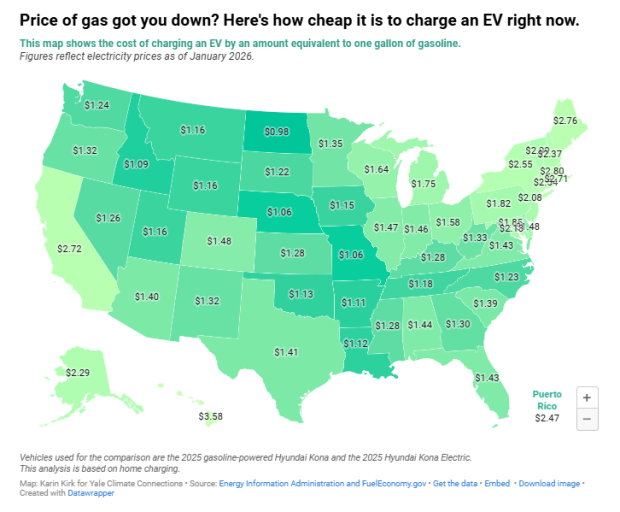
Research shows that transforming our transportation system to meet our climate goals can actually save households up to $5,000 a year by going electric and expanding accessible transportation options—the ability to instead choose transit or move around without a vehicle saves people even more money. These savings are even greater when oil prices spike. Providing access to these opportunities is what will really bring down our transportation costs, not continued dependence on fossil fuels.
Why electrification builds economic resilience
When transportation runs on oil, Northwest families remain vulnerable to a system controlled by a few powerful interests and disrupted by decisions far beyond any single person’s control. Cleaner transportation strengthens the climate, household budgets and the region’s stability. The more the Northwest shifts toward electric vehicles, transit, walking, biking and simply using less oil, the less exposed the region becomes to the next pipeline leak, refinery outage or global shock. Clean power made in the Northwest also keeps more economic activity local and supports jobs, innovation and a growing clean‑energy economy.
Clean energy offers a different path, one built on stability rather than volatility. Each step toward reliable, affordable clean energy brings more predictable costs, stronger local economies and long‑term benefits that communities can count on.