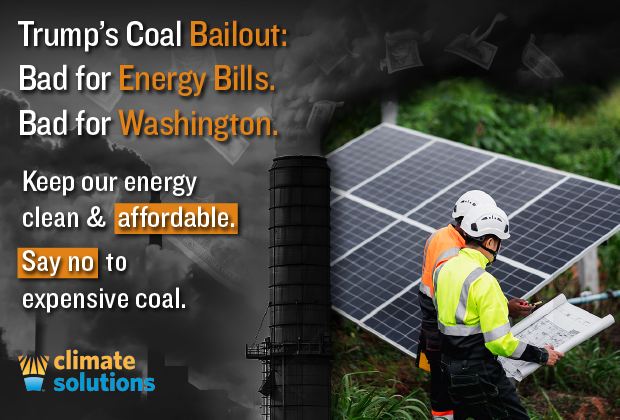
Note: We're taking action to challenge the Trump administration's illegal order attempting to keep coal on life support in Washington. Sign up here to get involved!
Washington has turned the page on coal, the world’s most polluting source of electricity. No Washington port handles coal export, and no power plants use coal as a fuel source. But now the Trump administration wants to unlawfully force the last coal-fired power plant in our state to stay open past its long-planned retirement.
Coal power has a well-deserved reputation for being the dirtiest and most expensive option for generating electricity. Burning coal dumps mercury and other toxins into our air and water, and produces huge amounts of greenhouse gas pollution, all while costing more to keep the lights on. Instead we’re building more homegrown, affordable resources like solar and wind energy to power our lives.
We’re not going to let the Trump administration dictate our energy future here in the Northwest by dragging us backwards to the waning coal era, especially as energy bills rise and the climate crisis worsens.
So how did we get here and what’s next?
A long fight for a clean energy future
Climate Solutions partnered with many others over years to help secure the Northwest region’s transition off dirty and expensive coal.
We worked to transition our electric sector from coal power to clean energy resources by passing groundbreaking laws, including Oregon’s Coal to Clean Law (2016), Washington’s Clean Electricity Transformation Act (CETA, 2019), and Oregon’s 100% Clean Law (2021). CETA effectively began the process to phase out coal from the state’s power grid, specifying that no coal can be included in Washington’s electricity rates after 2025.
We worked to stop NW coal export terminals as part of the Power Past Coal coalition. Standing alongside the Lummi Nation and other tribes with a long-term stake in the health of the region’s coastal waters, we effectively opposed coal giants’ efforts to use the Pacific Northwest as a staging ground to export coal overseas as domestic demand waned. Finally, we worked to retire the final coal-fired power plants in the Northwest.
A historic agreement to transition off coal
In 2011, Washington communities and leaders came together and committed to retire Washington’s only large coal-fired power plant in Centralia completely by the end of 2025. At the time, the Nixon-era TransAlta coal plant was the largest single source of greenhouse gas emissions in the state, responsible for 10% of Washington’s total climate pollution.
Climate Solutions joined with state leaders, utilities, labor unions, grid operators, and the coal plant owners themselves to carefully plan this transition off coal, securing replacement power and protecting reliability along the way. We were part of negotiations that led to a historic agreement in which TransAlta committed to a 2025 retirement date rather than upgrading the plant to operate with improved air and climate pollution controls.
Our broad coalition successfully passed Washington legislation to establish this coal phaseout deal, including broadly endorsed transition plans for workers and community investments. For years, the Centralia coal transition deal stood as a national model for a fair and just transition for workers and coal-dependent communities.
This plan to turn the page on coal in the Northwest, 15 years in the making, was on track. In 2020, Transalta retired the first of the two boilers at the Centralia coal plant. The last coal plant in Boardman, Oregon also closed in 2020 and was demolished in 2022. In anticipation of ending operations by December 31, 2025, Transalta had recently wound down its coal reserves and workforce and idled Centralia’s final boiler.
An illegal order to bail out coal in Washington
Mere weeks before the long-planned-for retirement of this last coal plant in Washington, The Trump administration threw an unprecedented and unlawful monkey wrench into the works. On December 16th, 2025—while many Washingtonians were experiencing catastrophic flooding—Trump’s Department of Energy attempted to seize control of our region’s power generation by issuing an illegal emergency order to force the decrepit Centralia coal plant to continue running past its legal retirement date. The 202(c) type of emergency order is only meant to be issued for true emergencies like natural disasters, not to bailout a coal industry that can’t otherwise compete with modern energy sources.
The emergency order purports to give Gridforce and Southwest Power Pool Western the authority to direct TransAlta to run the Centralia coal plant, even when the electricity is not needed or it is more expensive. But the truth is that there is no emergency shortage of electricity in Washington state. In fact, TransAlta themselves recently highlighted how well-supplied our region is with hydropower, and thus how unnecessary it is to keep this coal plant online..
There is no lawful basis for the coal plant to keep running. On top of that, Washington households and businesses will likely pay higher electricity bills if the plant stays online. A study by Grid Strategies estimated that the Trump Administration’s national push to bail out coal could cost utility ratepayers $3 billion. Communities will also be saddled with more toxic air pollution, climate harm, and contamination of soil and water if the coal plant is ordered to fire up again.
A bad deal for Washington
Keeping the coal plant in Centralia open is not about affordability or reliability; it is about clinging to an outdated, uneconomic fuel source at the public’s expense. Coal plants are retiring because they cannot compete in today’s modern energy market. Recently, President Trump ordered the Pentagon to buy coal power in order to use taxpayer money to subsidize the struggling fossil fuel that can’t otherwise compete with cheaper electricity sources.
Undoing years of negotiated agreements and long-term planning in Washington would inject chaos and uncertainty into the region’s energy system, drive up costs for utility ratepayers, and undermine Washington’s clean energy progress. This risk is exacerbated by the Trump Administration’s recent loosening of air pollution regulations on coal plants, meaning burning coal can dump more harmful neurotoxins like mercury, arsenic, and lead into our air and communities.
A similar saga playing out in Michigan offers a cautionary tale of how things could play out here. Trump’s DOE issued an emergency 202(c) order on the Campbell coal plant a week before the 63-year-old Michigan plant retired. Since then, the federal government has forced it to run even though the utility itself says the coal power isn’t needed. Local residents are on the hook to buy more expensive power while breathing the polluted air.
Washington communities meant it when we committed to moving past coal. And we won’t accept the Trump administration’s illegal efforts to send us backwards to a polluting, unnecessarily expensive power source. We stand by the commitment to retire the Centralia coal plant and are fighting this unlawful order in several ways.
What we’re doing to fight back - and how you can help!
- Challenging the Trump administration’s illegal order in court: Represented by EarthJustice, Climate Solutions is part of a federal lawsuit to challenge this illegal order to prop up the Centralia coal plant alongside other key organizations. Attorney General Nick Brown has also challenged the order on behalf of the State of Washington. We most recently filed on March 3rd in the 9th Circuit to try to overturn the emergency order. We also anticipate DOE may continue to extend its original 90-day emergency order (as it has done on other coal plants around the country), keeping our state’s energy transition in limbo for longer. Stay tuned for next steps!
- Passing state laws to account for coal pollution: This session, Climate Solutions worked with Washington legislators and partners to pass legislation that ensures that if the Centralia coal plant fires back up, it will be subject to our state laws that regulate climate and air pollution. The bill also removed the coal plant's sales and use tax exemption. Governor Ferguson quickly signed this bill into law, ending the coal power plant’s longstanding exemption that reflected the previous phase-out deal.
- Accelerating the buildout of clean energy: Climate Solutions is working to enable the faster build out of the clean energy and transmission we need to replace fossil fuels, especially in the face of federal attacks. This includes advocating for creation of a state transmission authority to more easily build out the grid we need (which also just passed the legislature!), participating in utility regulatory processes to ensure the clean energy transition is happening at speed, scale, and affordably, and supporting implementation of the Governor’s recent executive order to speed up the build out of solar, wind, and storage projects in Washington.
- Stay tuned for what’s next: There is a lot going on, and a lot more to do. Please sign up here to get involved!