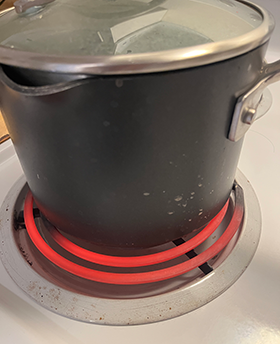
I grew up in New England cooking on a slow, “sh*tty electric” stove.
That’s the phrase a high school friend said when trying to cook at my house after school. We were venturing into crépes at the time and the hard-to-finesse burners made it tough to get the batter just right.
While I flirted with cooking a bit in high school and then in my first apartment, it was when I became a line cook in college one summer that I really learned—and when I discovered the difference between gas and slow electric cooking. Working on the line, I moved my way up to the gas grill and broiler. I trained up quickly, in part as the gas burners were so responsive and accelerated my learning.
After that summer, I never wanted to go back to electric again. Gas cooking became a top priority on my list whenever looking for a new place to live, including for the long time I was renter, if I had a choice.
Eventually, I had my own kids wanting to learn to cook. Coaching them, I watched closely and trained them to tuck in shirts to avoid clothing meeting flame, to keep things away from the burners to avoid fire risk, and to make sure burners were completely off when done.
A few years ago, I started to hear of some friends who had saved up to get a new type of electric stove called induction, with some remarkable—even magical–sounding—new features. For one thing, the new ranges didn’t actually get hot—they “induced” heat in the pots and pans—and thus removed much of the danger of touching hot cooking surfaces. They would be easier to clean, and would be way more efficient than the old electric models I knew and had avoided since my childhood.
But I didn’t really get all that at first. When my friends described their purchase it sounded like a lot of money; they also reported that they “had to get all new pans too.” I remember thinking: if I have to give up my grandmother’s cast-iron skillet for a new stove, that’s not going to be for me. Not interested.
During the pandemic while home with the kids (now middle schoolers) I wanted them to cook their own hot lunch. Yet at the same time, I was starting to hear more about the dangers of gas stoves and indoor air health and asthma risk – and how older stoves (like mine) can be leaky, intensifying the need to vent whenever cooking with gas by opening a window and/or using a proper stove vent (which I didn’t have, I realized).
I had always known the dangers of a leaky gas furnace (a story for another time) and made sure we had a carbon monoxide detector, But I had not made the connection that burning that same methane gas for cooking food involved the same dangers.
So I started to question my long-held preference for gas. It’s bad for our lungs, after all, and methane gas is unquestionably a global warming superpolluter. But replacing a kitchen stove is a major investment. And with other expenses, I couldn’t make it work to buy a new induction stove (not to mention my assumed added cost of replacing all my pans—more on that misconception later). So I had to put aside the possibility of a new induction stove and instead just remind the kids to run the vent and open a window when cooking.

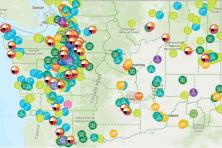
Then the wildfires in the fall of 2020 arrived-–the time right after Labor Day when it felt the whole broader region was covered in smoke if not fire too (see image). That pushed me to get creative—to engineer an affordable solution to reduce my gas cooking. I remember getting an alert from Puget Sound Clear Air Agency on the dangers of the bad air quality outside, and tips for keeping the air inside cleaner. One of them? Don’t use a gas stove. They explained that when the air quality outside reaches dangerous levels, opening kitchen windows or venting outside is not a healthy choice.
I had learned from a friend about another new tool—portable induction cooktops. So I visited a local kitchen supply story to check out options. For $100 (still an amount not everyone easily has on hand extra, I recognize), I selected a one-burner induction unit that I could plug in next to my gas stove.
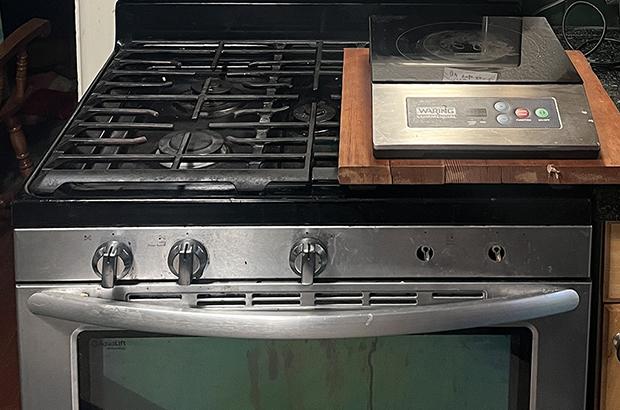
When I got home, I removed the knobs for two of our oven’s gas burners—making them safely nonfunctional—and set the electric cooktop right on top. Boom—I had a hybrid gas electric range in my kitchen! Being new to induction cooking, I wasn’t sure how the responsiveness would compare with gas burners; I soon was amazed by how little time it took, for example, to bring liquid to a boil. When the kids started using, it we also realized the additional benefits of lower risk of burns, and easier-to-clean spills.
Now, if I just need to heat some water, or cook a one-pan meal, I can skip the gas burners entirely. I can use multi-burner strategies, too: if I am making a dish requiring boiling water, I can dedicate the induction burner for the “longer job” and then just use the gas burner for a quick sauté on the side.
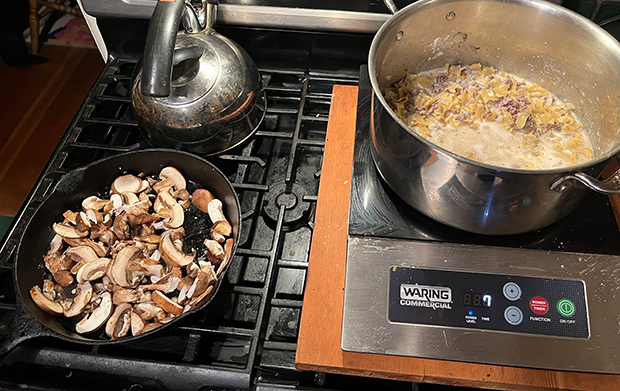
For several years I kept that setup while saving up for some home appliance upgrades. While I had my kitchen hybrid, I was able to map a plan to get the whole house off gas (also another story). When I replaced my old gas furnace with a heat pump, the energy savings allowed me to afford a full size electric oven with an induction range. The appliance technician who delivered my new oven told me that lots of people were making the switch. What was the biggest reason, I asked? “Indoor health is what I hear over and over,” they said.
I have kept my portable burner to loan to friends to try it out. In some places, you can even check a portable burner out of the library for up to two weeks!
So what about those pans? Well, my friends who told me I would have to buy all new pans were mostly wrong. While aluminum pans won’t work with induction ranges, flat-bottomed stainless steel and cast iron pots and pans work great. I got this helpful tip from an Electrify Now webinar: hold a magnet on the bottom of any pan. If the magnet sticks, that pan will work on an induction burner. So my grandma’s hand-me-down cast iron still rules in the all-electric kitchen.
Through this I learned it was okay to change my mind (and eat my words a bit while I enjoyed the beautifully cooked meal from an electric induction burner, as this sure wasn’t sh*tty electric). I was also reminded how fun it is to come up with affordable hacks and share ideas with friends for what’s working—to flip the switch to more clean energy, and update my idea of what’s possible in our daily lives... including changes that might at first seem out of reach.